
The Usul Terminology Related to Taklifi Rulings in Imam Al-Qarafi’s Anwar al-Buruq
Article Sidebar
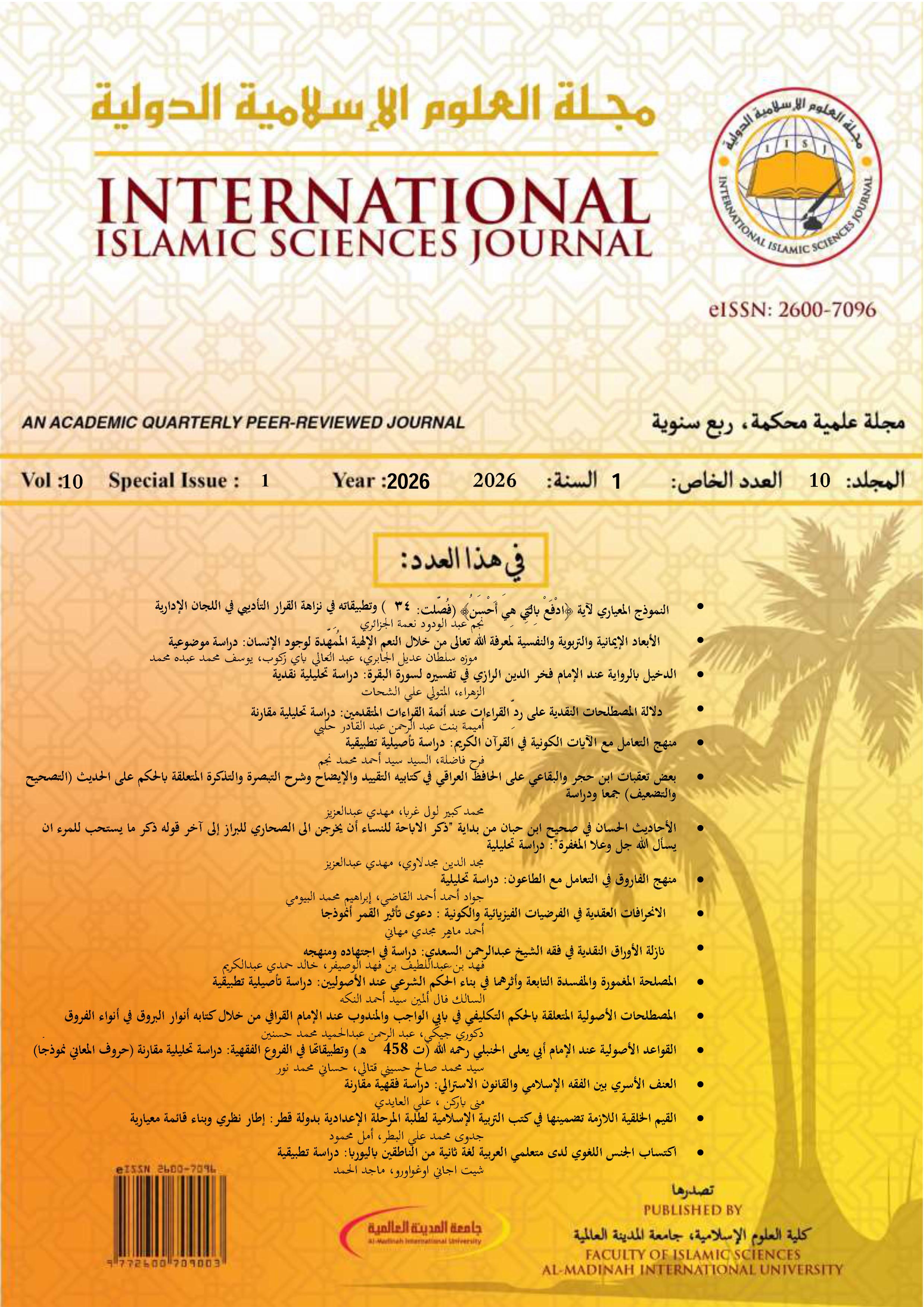
Main Article Content
Abstract
This article examines the usul al‑fiqh terminology related to taklifi rulings in Imam Al‑Qarafi’s seminal work Anwar al‑Buruq fi Anwaʾ al‑Furuq, viewing it as a key to understanding his methodological framework within the Maliki school. The research problem arises from the difficulty of precisely defining Al‑Qarafi’s taklifi‑ruling terms and from the jurisprudential consequences of terminological variation, particularly its impact on whether juristic disagreements are classified as merely semantic or genuinely substantive. The study seeks to identify the main usuli terms that Al‑Qarafi employs for taklifi rulings, to analyze their definitions and the fine distinctions between them, and to assess the extent of their agreement or divergence from the terminology of other Maliki and non‑Maliki usul scholars. Methodologically, the research adopts an inductive, analytical and comparative approach by tracing the occurrences of these terms in Anwar al‑Buruq, examining their linguistic and technical features, and comparing them with the broader usul literature. The findings indicate that Al‑Qarafi constructs a coherent terminological system in the field of taklifi rulings, in which usuli terms function as methodological tools for explaining the causes of disagreement rather than as interchangeable labels. The study further shows that neglecting this terminological system leads to confusion between semantic and substantive disagreement and to inconsistency in understanding and applying Maliki legal rulings.
Article Details

This work is licensed under a Creative Commons Attribution 4.0 International License.