
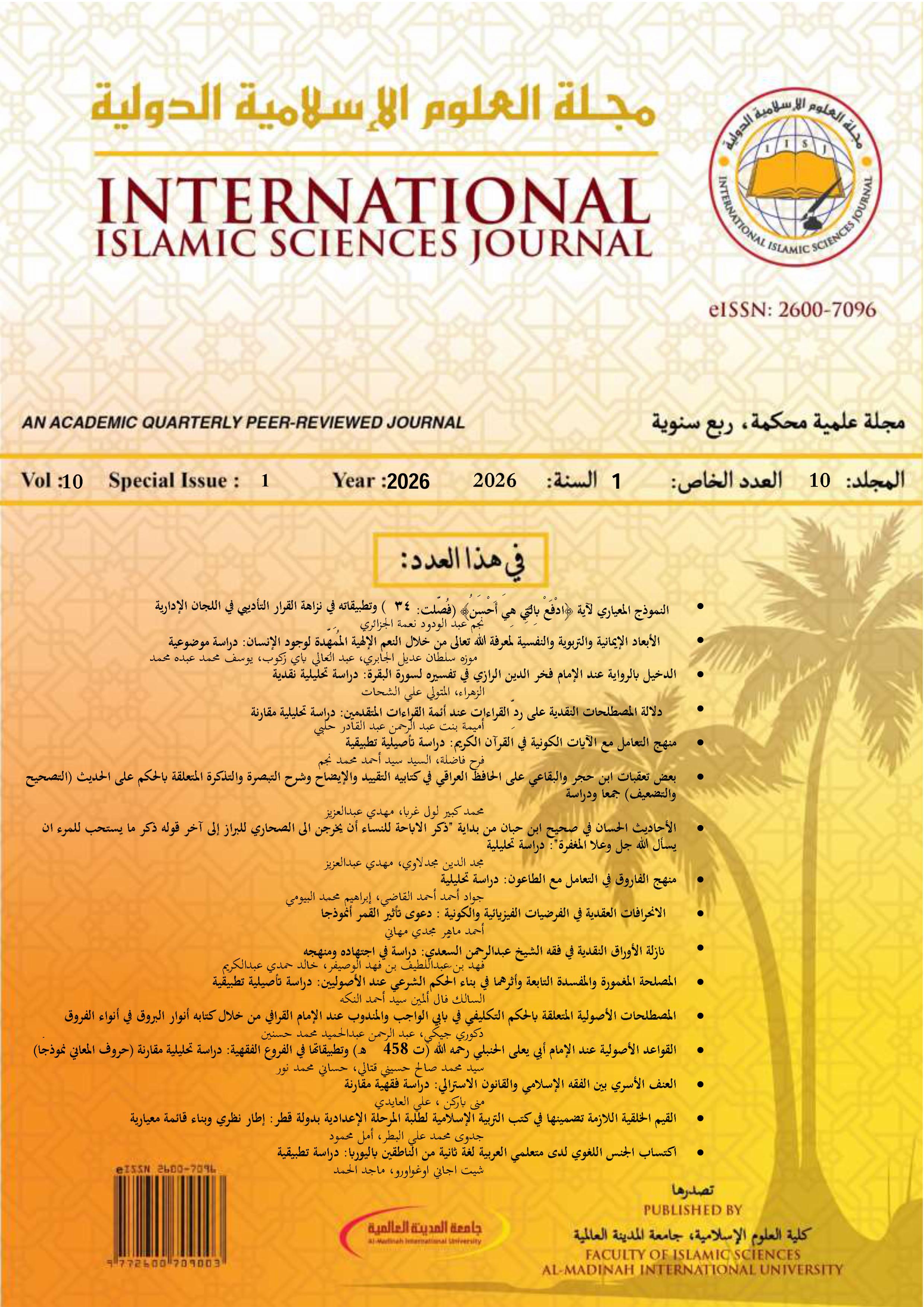
Moral Values Required for Inclusion in Islamic Education Textbooks for Preparatory Stage Students in the State of Qatar: A Theoretical Framework and Development of a Standards-Based List
Article Sidebar
Main Article Content
Abstract
This study aims to develop a theoretical framework and a standards-based list of the moral values required for inclusion in the Islamic Education textbooks prescribed for preparatory-stage students in the State of Qatar. This objective is grounded in the importance of school curricula in developing learners’ personalities and shaping their value systems, particularly during an age characterized by rapid cognitive, emotional, and social development and by the formation of attitudes and behavioral patterns. The problem addressed by the study stems from the need for a standardized reference framework to guide the selection of moral values appropriate for this educational stage, given the variation among lists used in educational studies and the differences in the foundations upon which such lists have been developed. The study employed the descriptive-analytical approach by reviewing the literature on Islamic education and previous studies, analyzing the objectives of Islamic Education and the educational policy of the State of Qatar, and drawing upon the Islamic sources represented by the Holy Qur’an and the Prophetic Sunnah to derive a preliminary list of moral values considered necessary for preparatory-stage students. The list was subsequently formulated as a questionnaire and presented to a group of specialists in curriculum studies, Islamic education, and educational measurement and evaluation to verify its comprehensiveness, clarity, appropriateness to the characteristics of the educational stage, and applicability to the content analysis of textbooks. The study resulted in the development of a standards-based list comprising thirty moral values, distributed across several domains. The most prominent values included truthfulness, honesty, justice, benevolence, tolerance, dutifulness to parents, compassion, modesty, cooperation, keeping promises, responsibility, altruism, respect for rules and regulations, and appreciation of knowledge. The list also included an operational definition for each value, specifying its meaning within the context of content analysis and facilitating its application in evaluating Islamic Education textbooks. This finding highlights the importance of moving beyond merely identifying the values presented in textbooks toward establishing a rigorous standardized reference framework that can serve as a basis for curriculum development, content analysis, and curriculum evaluation. The study recommends utilizing the proposed standards-based list in developing Islamic Education textbooks for the preparatory stage in the State of Qatar, designing content-analysis and curriculum-evaluation instruments, and conducting empirical studies to determine the extent to which these values are incorporated into textbooks.
Article Details

This work is licensed under a Creative Commons Attribution 4.0 International License.