
Submission Guidelines
SUBMISSION PREPARATION CHECKLIST
As part of the submission process, authors must ensure compliance with the following. Submissions that fail to meet these requirements may be returned:
✅ Confirm that the submission is original and has not been previously published. If there are exceptions, an explanation must be provided in the "Comments to the Editor" section.
✅ Submit the manuscript as a blind document, excluding any information identifying the author(s), to facilitate double-blind peer review.
✅ Upload a separate document that includes the manuscript’s title, full names of the author(s), their affiliations, and contact information.
✅ Provide a list of at least three (3) recommended reviewers, including their full names, institutional affiliations, and valid email addresses.
✅ Include an abstract in English, clearly stating the problem, objectives, methodology, findings, and the contribution of the research.
✅ Attach a plagiarism report (Turnitin or equivalent) with a similarity index of less than 20%.
✅ Ensure the manuscript is in Microsoft Word format (.doc or .docx).
✅ Verify that the manuscript conforms to the journal’s stylistic and bibliographic standards, as outlined in the official article template.
AUTHOR GUIDELINES
The International Islamic Sciences Journal (IISJ) publishes unpublished, original research-based articles in Arabic and English.
Submission Requirements
- a) Articles must be between 4,000 and 8,000 words in length.
b) Each submission must include an abstract in both English and Arabic, not exceeding 300 words each, along with 3–5 keywords in both languages.
c) A complete list of references (bibliography) must be provided, formatted according to the APA 7th edition
d) Submissions must reflect academic writing standards, with properly formatted footnotes where applicable.
e) Transliteration of Arabic terms must follow the journal’s official guidelines.
f) All articles are initially reviewed by the editorial team for relevance and suitability. Eligible manuscripts will then undergo double-blind peer review by at least two independent experts in the relevant field.
g) Views expressed in published articles are solely those of the author(s) and do not necessarily represent the views of IISJ or its affiliated departments.
h) Upon publication, Authors retain copyright for all articles published in IISJ.
FONT AND FORMATTING SPECIFICATIONS
Manuscripts must adhere to the following font and formatting guidelines based on the language used:
For Arabic Manuscripts
- Title: Traditional Arabic, 18 pt, bold
- Abstract: Traditional Arabic, 14 pt, bold
- Main Text: Traditional Arabic, 16 pt, regular
- Footnotes: Traditional Arabic, 12 pt, regular
- Subheadings: Traditional Arabic, 16 pt, bold
For English Manuscripts
- Title: Times New Roman, 14 pt, bold
- Abstract: Times New Roman, 10 pt, regular
- Main Text: Times New Roman, 12 pt, regular
- Footnotes: Times New Roman, 8 pt, regular
- Main Headings: Times New Roman, 14 pt, bold
- Subheadings: Times New Roman, 12 pt, bold
All text must be consistently formatted, and manuscripts must be submitted in Microsoft Word (.doc/.docx) format.
SUBMISSION RULES
1.0 HOW TO PREPARE PAPERS
Manuscripts should be unpublished original research on the themes of Islamic economic.
Manuscripts should be prepared on A4 format with 2.5 cm margins left, 2.5 cm right, 3.0 cm top and cm 3.0 bottom. Header and footer shall be positioned 1 cm from the edge respectively.
Centred at the top of the first page of a manuscript should be the complete title of the manuscript, name(s) of author(s) affiliation(s), mailing and email address(es), then the abstract under the heading ABSTRACT (in English) and ABSTRACT (in Arabic) (in Times New Roman, 10 points), not exceeding 300 words, keywords not more than five keywords, in bold, Times New Roman, 10 points) and followed by the text.
The abstract, written in English, should be no longer than 300 words and must be written in the past tense. The abstract should give a succinct account of the objectives, methods, results and significance of the matter. The unstructured abstract for an Original Research article should consist of six paragraphs unlabelled Background, Aim, Setting, Methods, Results, Conclusion and Contributions. The latter, is the only labelled heading within the abstract.
- Background: Summarise the social value (importance, relevance) and scientific value (knowledge gap) that your study addresses.
- Aim: State the overall aim of the study.
- Setting: State the setting for the study.
- Methods: Clearly express the basic design of the study, and name or briefly describe the methods used without going into excessive detail.
- Results: State the main findings.
- Conclusion: State your conclusion and any key implications or recommendations.
The text should be typed and single-spaced, using Times New Roman font version 5 and above for Roman characters, including the transliteration, Paragraphs should be separated by double spacing.
1.1 Language Used
Manuscripts must be written in Arabic and English only. Article in other Languages are not considered.
1.2 Figures and Tables
A figure, table and illustration should be placed on the same page as far as possible, otherwise it may be placed on the immediate following page.
1.3 Sections and Subsections
Sections and subsections should be given the titles respectively. For subsections, the first letter of each word should be in capital letter, followed by small letters.
1.4 Footnotes
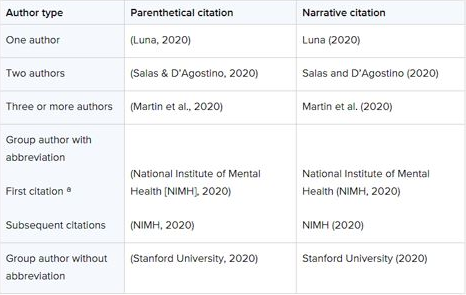
The IISJ adopted the author-date system in APA style in citing references, and in both parenthetical and narrative citation format. Example of the citation is as follow:
1.5 Acknowledgements
The names of people who have helped in the work can be included in this section. The source of funding and the codes of the research grants should also be given in this section.
1.6 References
References of each manuscript should follow the APA style (https://opentextbc.ca/researchmethods/chapter/american-psychological-association-apa-style/)
References should be placed in alphabetical order at the end of the paper, and typed in a single-spaced, using Times New Roman font 12.
Authors should provide direct references to original research sources whenever possible. References should not be used by authors, editors, or peer reviewers to promote self-interests.
Ali Hanafiah, Datuk & Tun Shah Ashari. (12-17 August 1999). ‘The effect of DNA testing on convicted felons in Malaysia’. In Proceeding of the International Seminar on DNA Testing and Their Effects on Human Beings. Kuala Lumpur.
1.7 Turnitin Report & Proofreading Services for Non-English Authors
It is required to include a Turnitin report with the submitted article. Non-native authors are encouraged to seek proofreading services to improve the quality and language proficiency.
1.8 Open Journal System
The journal exclusively accepts manuscripts that are submitted through the Open Journal System. All submissions, progress checks and decisions will be handled through the system.
Important notes:
- For Noble Quranic text (Arabic) used font AHT Times New Roman follow transliteration-guideline (available on official website) the translation must be italic, middle align and from the editions of Muhammad Taqi-ud-Din al-Hilali and Muhammad Muhsin Khan only, publish by King Fahd complex for the printing of the Holy Qurʾān, Madinah, K.S.A, 2000.
- The footnote style for Quranic verse should be as follows: (Q58:7; Hilali & Khan, 2000). Whereas the reference style should be as follows:
Muhammad T. H., & Muhammad M. K. (2000). Translation of the meaning of the noble Qurʾan in the English language, Madinah, King Fahd complex for the printing of the Holy Qurʾan. K.S.A.
- For Hadith text (Arabic) used font AHT Times New Roman follow transliteration-guideline (available on official website) the translation in the body of manuscript must be italic, middle align and from the authentic books of hadith only.
- The footnote style for Hadith should be as follows: (14:1359; Shuʿab al-īmān of al Bayhaqī, 2003). Whereas the reference style should be as follows:
Aḥmad bin Ḥusayn bin ʿAliyy al Bayhaqī. (2003). The Branches of Faith (1st ed.). Maktabah ar-Rushd.
FORMAT
Kindly use the IISJ Template for further reference.
TRANSLITERATION
- Consonant
|
Arabic |
Latin |
Example |
|
|
Arabic |
Latin |
||
|
ء |
فَأرٌ |
farun |
|
|
أ |
(a,i,u) |
أَحكَام |
aḥkām |
|
ب |
b |
بَابٌ |
bābun |
|
ت |
t |
تَمْرٌ |
tamr |
|
ث |
th |
ثَلاَثَ |
thalātha |
|
ج |
j |
جَبَلٌ |
Jabal |
|
ح |
ḥ |
حَدِيث |
ḥadīth |
|
خ |
kh |
خَالِـدْ |
khālid |
|
د |
d |
دِين |
dīn |
|
ذ |
dh |
مَذهَب |
madhhab |
|
ر |
r |
رَاهِبٌ |
rāhib |
|
ز |
z |
زَكِي |
zakī |
|
س |
s |
سَلاَم |
salām |
|
ش |
sh |
شَرَبَ |
sharaba |
|
ص |
ṣ |
صَدْرٌ |
ṣodrun |
|
ض |
ḍ |
ضَار |
ḍār |
|
ط |
ṭ |
طَهُرَ |
ṭahura |
|
ظ |
Ẓ |
ظَهْرٌ |
z̧hohr |
|
ع |
c |
عَبْدٌ |
cabdun |
|
غ |
gh |
غَيـبٌ |
ghayb |
|
ف |
f |
فَاتِحَةٌ |
Fātihah |
|
ق |
q |
قَبَسٌ |
qabas |
|
ك |
k |
کِتَابٌ |
kitāb |
|
ل |
l |
لَيلٌ |
layl |
|
م |
m |
مُنِير |
munīr |
|
ن |
n |
نِقَابٌ |
niqāb |
|
و |
w |
وَعَدَ |
wacada |
|
ه |
h |
هَدَفٌ |
hadaf |
|
ي |
y |
يُوسُف |
Yūsuf |
b. Short Wovel
|
Arabic |
Latin |
Example |
|
|
Arabic |
Latin |
||
|
ـَ |
a |
كَتَبَ |
kataba |
|
ـِ |
i |
عَلِمَ |
calima |
|
ـُ |
u |
غُلِبَ |
ghuliba |
c. Long Wovel
|
Arabic |
Latin |
Example |
|
|
Arabic |
Latin |
||
|
ا ، ى |
ā |
عَالَم ، فَتَى |
cālam , fatā |
|
ي |
ī |
عَلِيم ، دَاعِي |
calīm , dācī |
|
و |
ū |
عُلُوم ، اُدعُو |
culūm , ´udcū |
d. Diphthong
|
Arabic |
Latin |
Example |
|
|
Arabic |
Latin |
||
|
أَو |
aw |
أَولَاد |
aulād |
|
أَيّ |
ay |
أَيَّام |
ayyam |
|
إِيّ |
iy |
إِيَّاكَ |
iyyāka |