
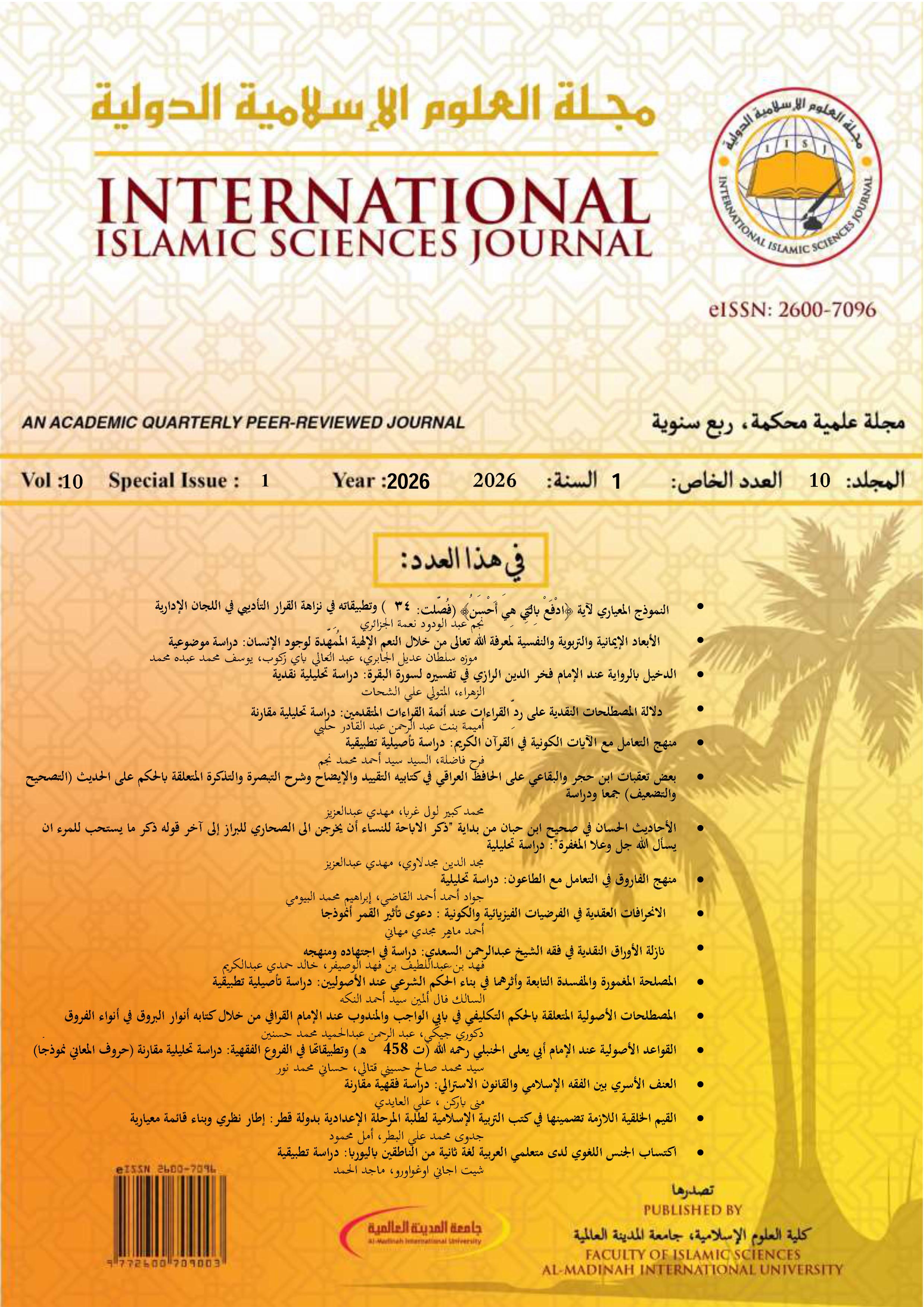
Usūlī Legal Principles in the Works of Imām Abū Yaʿlā al-Ḥanbalī (d. 458 AH) and Their Applications in Jurisprudential Branches: An Analytical Comparative Study (Taking the Particles of Meaning as a Case Study)
Article Sidebar
Main Article Content
Abstract
This study examines the legal-theoretical (uṣūlī) principles formulated by al-Qāḍī Abū Yaʿlā al-Ḥanbalī (d. 458 AH) through an analytical and comparative approach. It aims to explore his methodology in formulating these principles and to demonstrate their impact on subsidiary juristic rulings particularly in the domain of particles of meaning (ḥurūf al-maʿānī). The research problem lies in identifying the uṣūl al-fiqh principles employed by Qadi Abu Ya‘la, examining their application to juristic branches, and assessing the extent to which these principles are reflected in his jurisprudential applications. The study seeks to collect the relevant principles from his works, analyze their juristic applications, and compare them with the views of other scholars across different legal schools. It employs an inductive method for data collection, an analytical method for examining the principles, and a comparative method to highlight similarities and differences. The findings reveal that Abū Yaʿlā is distinguished by concise yet comprehensive formulations, a strong reliance on textual and linguistic evidence, and a precise integration between linguistic indications and legal rulings. His approach demonstrates a well-structured and effective methodology in linking theoretical principles with practical jurisprudence.
Article Details

This work is licensed under a Creative Commons Attribution 4.0 International License.