
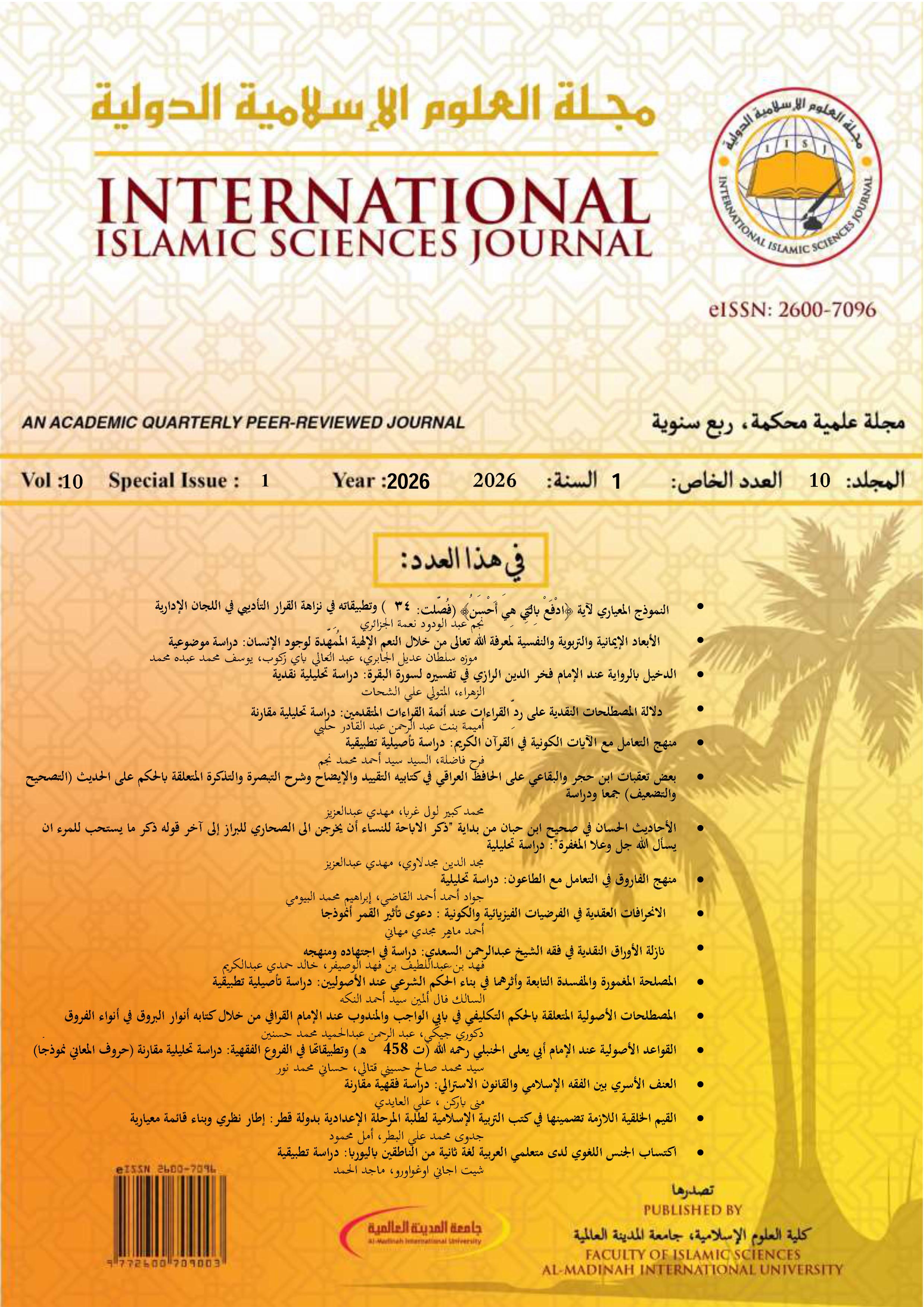
The Hasan Hadiths in Ṣaḥīḥ Ibn Ḥibbān: An Analytical Study from the Beginning of the Chapter on the Permissibility for Women to Go Out to Open Areas to Relieve Themselves to the End of the Chapter on What Is Recommended for a Person to Ask Allah, Glorified and Exalted, for Forgiveness
Article Sidebar
Main Article Content
Abstract
This study is derived from a master's thesis in the field of Hadith and its sciences. It examines the ḥasan hadiths cited by Imam Ibn Hibban in his Ṣaḥīḥ. The thesis aimed to clarify the concept of the ḥasan hadith, examine Ibn Ḥibbān’s methodology for accepting and classifying hadiths in his Ṣaḥīḥ, and identify the methodological basis for his inclusion of certain narrations that later hadith scholars classified as ḥasan in the work that he entitled al-Musnad al-Ṣaḥīḥ. To achieve these objectives, the researcher employed the descriptive-inductive method to identify and compile the hadiths under investigation and the analytical method to examine their chains of transmission and evaluate them in accordance with the established principles of hadith criticism. The study also demonstrated that Ibn Ḥibbān’s inclusion of narrations later classified as ḥasan does not diminish the scholarly standing of his Ṣaḥīḥ. Rather, it reflects his broader conception of ṣaḥīḥ, which encompasses narrations that are acceptable and authoritative as evidence, even if they do not satisfy the more restrictive definition established by later scholars. Furthermore, the study found that the classification of the narrations examined as ḥasan was generally attributable to minor deficiencies in the precision of certain narrators, differences among hadith critics regarding their reliability, or the existence of corroborative transmissions (mutābaʿāt) and supporting reports (shawāhid) that strengthened the narrations. This confirms that hadith criticism is a comprehensive evaluative process based on the collective assessment of transmission routes, contextual indicators, and both the chain of transmission and the text of the hadith, rather than on the evaluation of an isolated chain alone.
This thesis contributes to a clearer understanding of Ibn Ḥibbān’s methodology in hadith criticism and authentication and highlights the impact of the terminological differences between early and later hadith scholars on the evaluation of narrations, thereby providing a more accurate appreciation of his scholarly methodology and the status of his Ṣaḥīḥ within the hadith tradition.
Article Details

This work is licensed under a Creative Commons Attribution 4.0 International License.