
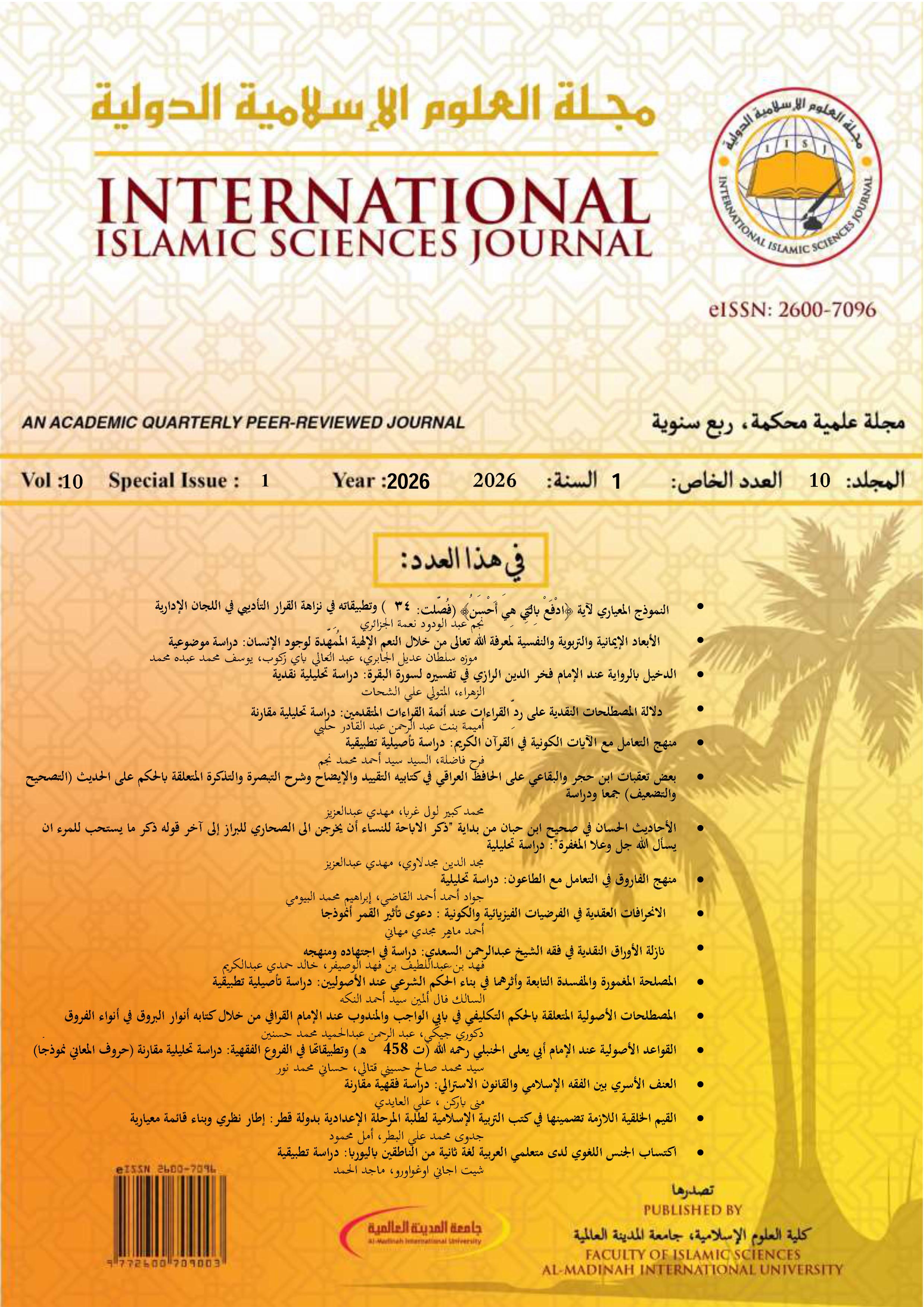
Al-Dakhīl by Transmission in Fakhr al-Dīn al-Rāzī's Interpretation of Sūrat al-Baqarah: An Analytical and Critical Study
Article Sidebar
Main Article Content
Abstract
This study examines al-Dakhīl bi al-Riwāyah (spurious transmitted narrations) in Fakhr al-Dīn al-Rāzī's Mafātīḥ al-Ghayb, with particular reference to his interpretation of Sūrat al-Baqarah. The study aims to identify transmitted reports that do not meet the accepted standards of authenticity in Qur'anic exegesis and to analyze al-Rāzī's approach to these narrations. The research employs inductive, analytical, and critical methods. The inductive method is used to collect the relevant narrations, while the analytical and critical methods are applied to evaluate their authenticity and interpretative function in light of the principles of Qur'anic exegesis and hadith criticism. The findings indicate that the spurious transmitted narrations in al-Rāzī's commentary on Sūrat al-Baqarah include weak reports, Isrāʾīliyyāt, and other narrations lacking reliable evidential value. Al-Rāzī's treatment of these narrations varies between mere transmission, critical discussion, and explicit rejection. The study highlights the importance of distinguishing authentic from unauthentic narrations in order to preserve the integrity of Qur'anic interpretation and to better understand al-Rāzī's exegetical methodology.
Article Details

This work is licensed under a Creative Commons Attribution 4.0 International License.