
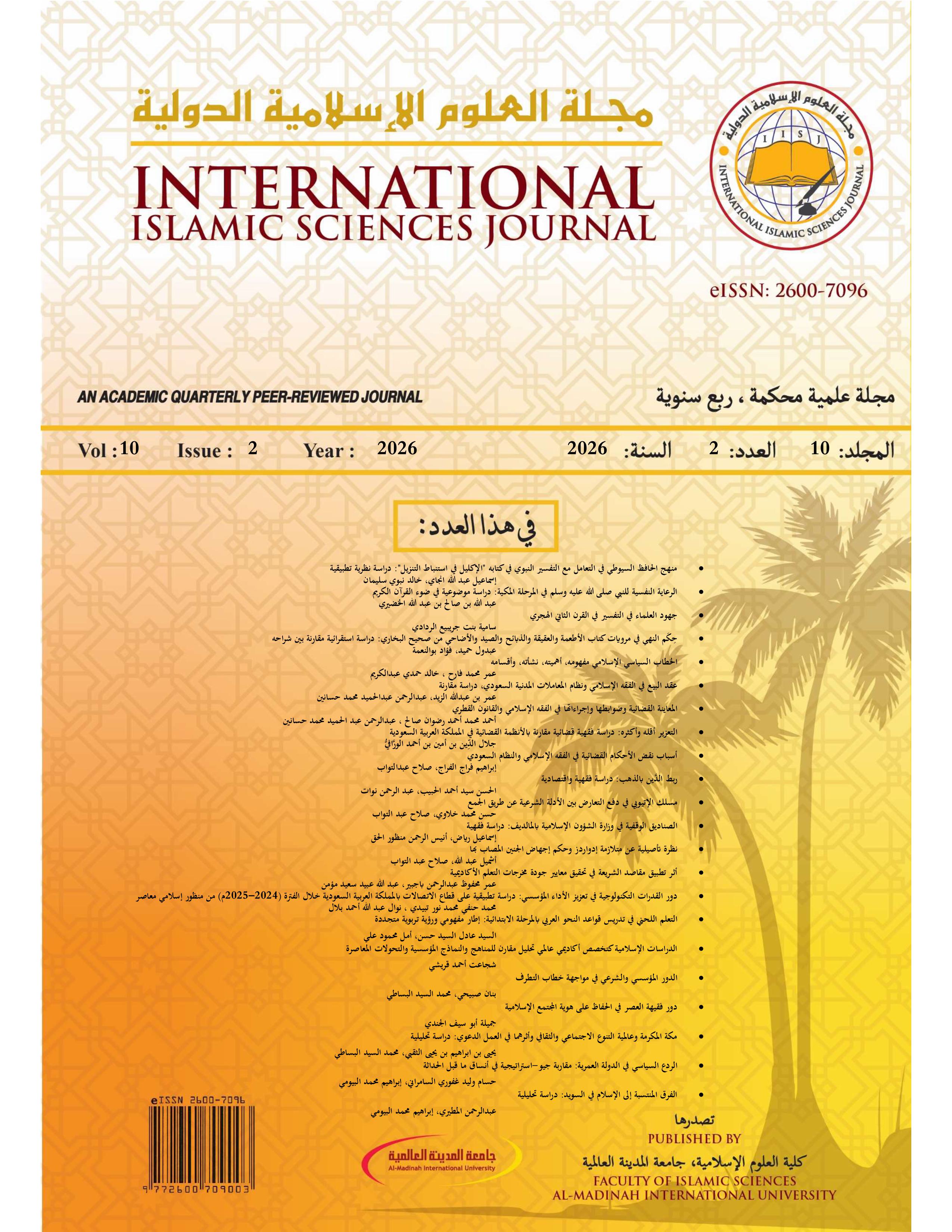
The Methodology of Al-Suyuti In Dealing with Prophetic Exegesis in His Book Al-Iklil Fi Istinbat Al-Tanzil: A Theoretical and Applied Study
Article Sidebar
Main Article Content
Abstract
Al-Iklil fi Istinbat al-Tanzil by al-Hafiz al-Suyuti is one of his most significant works, in which he employs a distinctive methodology in addressing Prophetic exegesis, adhering to it exclusively whenever the report is authentically established. This principle is applied systematically across seven key issues. The present study aims to elucidate Suyuti’s methodology, situate it within the broader spectrum of exegetical approaches, and identify the principles and rules governing the engagement with Prophetic interpretation. It also examines selected practical examples following a descriptive-analytical approach. The study identifies five main approaches adopted by exegetes in handling Prophetic interpretive statements: exclusive reliance on the Prophetic report; inconsistent application oscillating between restriction and generalization; neglect of the report; citing it while giving precedence to other interpretations; and integrating it within broader exegetical considerations. The first three approaches are methodologically sound, with exclusive reliance being the most robust, whereas the latter two are not recommended when the report is authentic. Finally, the analysis confirms that Suyuti’s choices in all applied examples consistently follow his core principle—reliance on authenticated Prophetic exegesis—while adopting general interpretation only in the absence of any contradiction.
Article Details

This work is licensed under a Creative Commons Attribution 4.0 International License.