
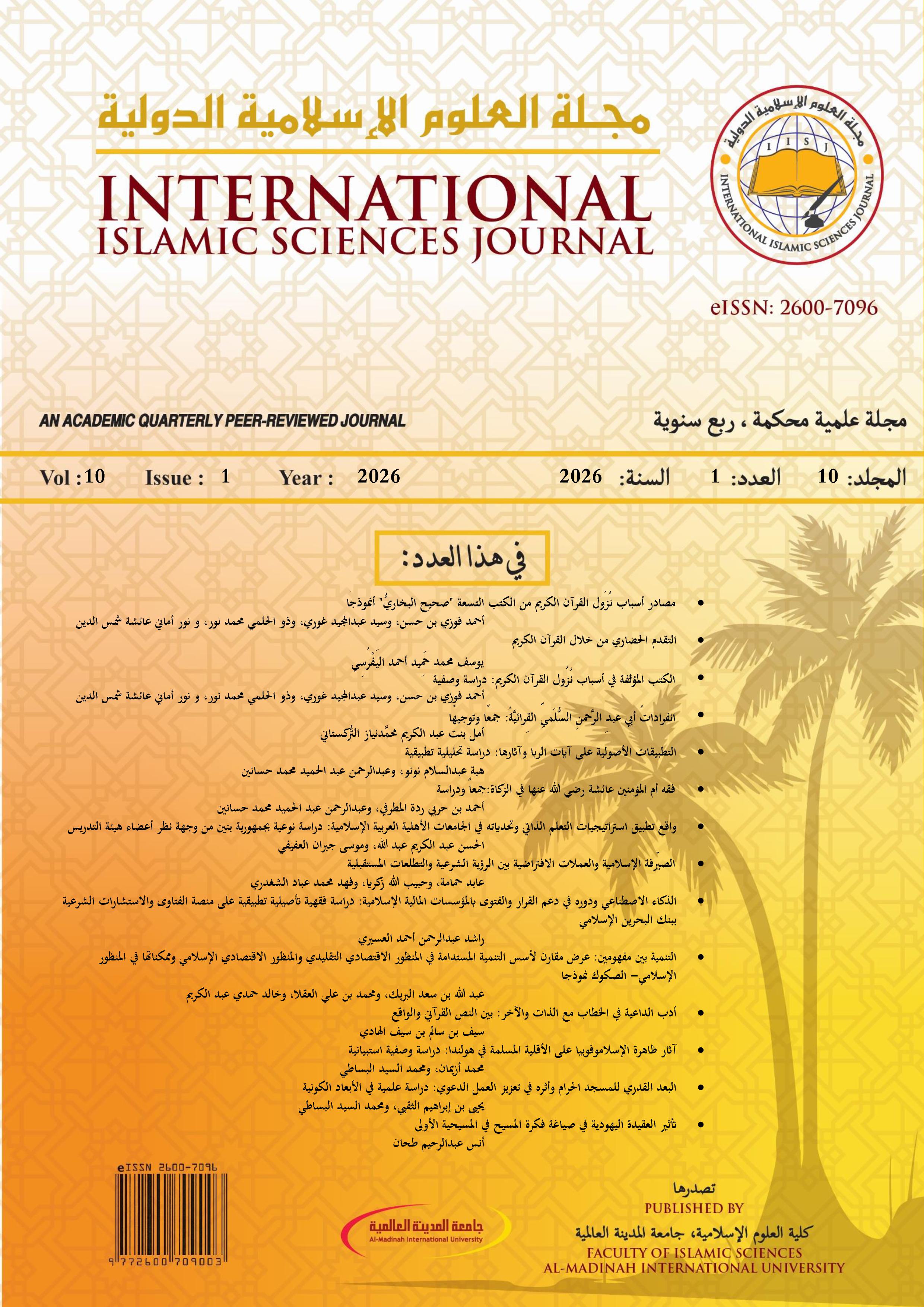
The Jurisprudence of the Mother of the Believers Aisha may Allah be pleased with heron Zakat: A Compilation and Study
Article Sidebar
Main Article Content
Abstract
This research focused on collecting and studying the jurisprudence of the Mother of the Believers, Aisha - may God be pleased with her - regarding zakat. The research problem was represented in questioning the effects of the Mother of the Believers, Aisha - may God be pleased with her - on the jurisprudence of zakat, its degree, the jurisprudence derived from it, and those who agreed and disagreed with it. A previous study was limited to the jurisprudence of Lady Aisha - may God be pleased with her - in the aspects of purification and prayer, and the need remains urgent to complete the aspect of worship with the study; so the research came to fill that gap.It aims to reveal the narrations from the Mother of the Believers, Aisha, on the jurisprudence of zakat, and to explain her jurisprudence derived from those narrations, and to clarify those who agreed and disagreed with her from among the Companions, the Successors, and the four jurists and their evidence; employing the inductive and analytical method in collecting the narrations from the jurisprudence of Lady Aisha - may God be pleased with her - and analyzing her statements and opinions, and the descriptive method; to study the narrations of her jurisprudence - may God be pleased with her - on zakat and its interpretation, and the comparative method, to compare those narrations and discuss them, and to clarify what is most correct.The study divided the issue into three sections: first, zakat on jewelry; second, zakat on buried treasure; and third, zakat on debt. The research yielded several findings, most notably that two narrations were transmitted from Aisha (may God be pleased with her) regarding zakat on jewelry. The first narration states that she did not consider zakat obligatory on jewelry, a view shared by the Maliki, Shafi'i, and Hanbali schools of thought, while the Hanafi school disagreed. The second narration states that whoever finds buried treasure has the right to own it, and that one-fifth (khums) should be taken from it. This is why she strongly condemned the man who found buried treasure and handed it all over to the ruler, a view shared by the four major schools of Islamic jurisprudence.
Article Details

This work is licensed under a Creative Commons Attribution 4.0 International License.