
The Advancement of Civilization Through the Noble Quran
Article Sidebar
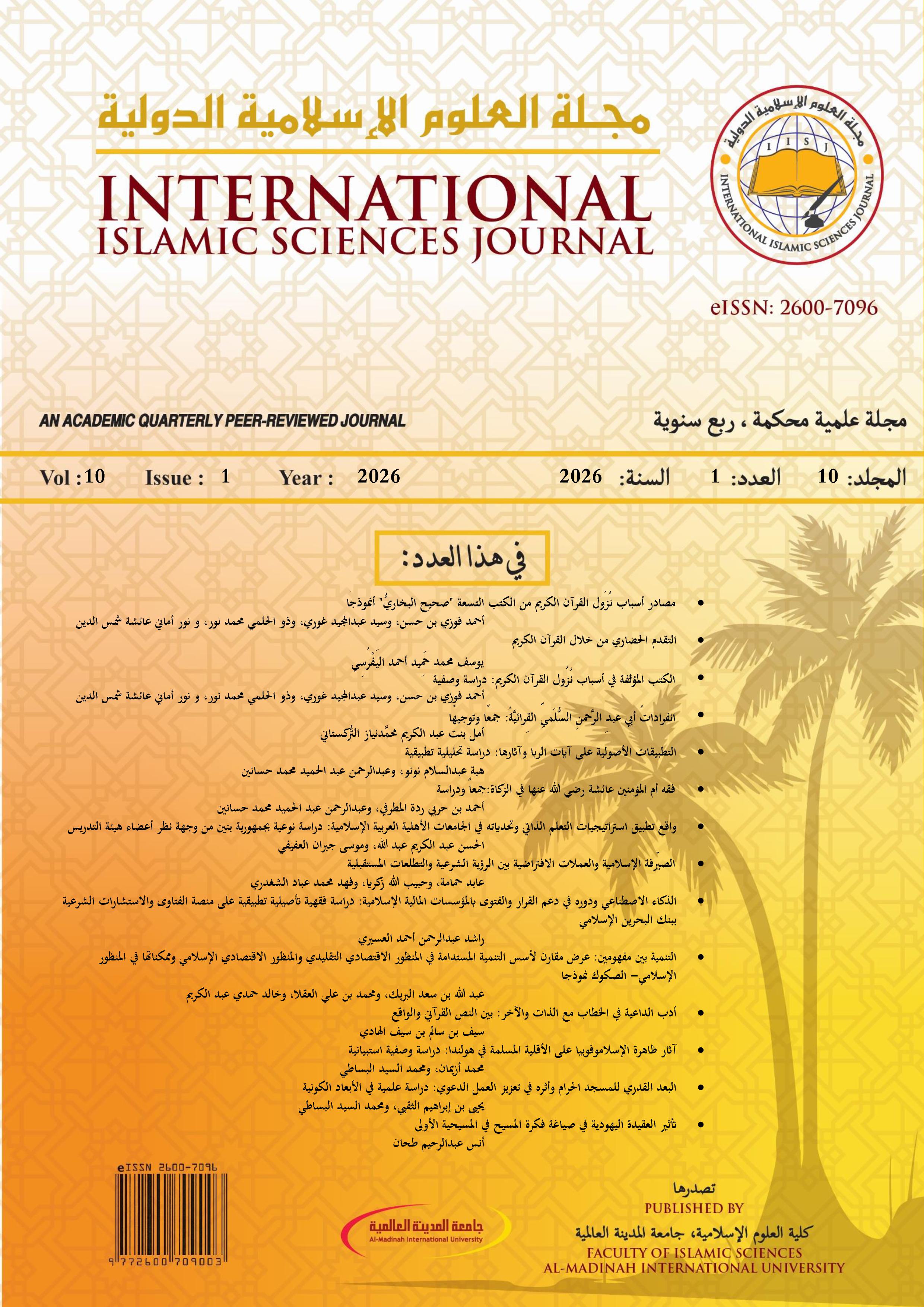
Main Article Content
Abstract
This study examines the concept of civilization and civilizational progress, as well as the role of the fundamental Islamic objectives in promoting development and societal construction in light of the Holy Qur’an, which represents one of the most important sources of knowledge and guidance for humanity. The Qur’an has given considerable attention to the civilizational dimension of nations and societies, as reflected in its discourse on the divine laws governing human communities and its presentation of the experiences of previous nations such as ʿĀd, Thamūd, the Pharaohs, and Sabaʾ, illustrating the causes of their prosperity or decline according to their adherence to or deviation from divine values.Allah Almighty says: “Have you not considered how your Lord dealt with ‘Ād? (6) With Iram—who had lofty pillars? (7) The like of whom had never been created in the lands? (8) And Thamūd, who carved out the rocks in the valley? (9) And Pharaoh, the owner of mighty structures? (10) Who transgressed in the lands? (11) And increased therein corruption? (12) So your Lord poured upon them a scourge of punishment? (13) Indeed, your Lord is ever watchful. (14)” (Qur’an 89:6-14).The study also discusses the factors that contribute to the emergence, development, continuity, and decline of civilizations as indicated in Qur’anic verses, highlighting the role of essential values such as justice, ethics, unity, cooperation, and equality in building stable societies, as opposed to the causes of decline such as disbelief, injustice, and excessive luxury.The study adopts an inductive-analytical approach, through the thematic induction of Qur’anic verses related to the rise, progress, and decline of civilizations, followed by a civilizational and Sunnah-based analytical examination to reveal the divine laws and civilizational values governing the movement and development of societies in light of Islamic objectives. The study concludes that the Qur’an presents a comprehensive civilizational framework based on a system of values and principles that constitute the foundation for the advancement and sustainability of nations. Adherence to these values—such as justice, ethics, and cooperation—represents a key factor in achieving civilizational progress, whereas deviation from them leads to the weakness, decline, and eventual collapse of civilizations.
Article Details

This work is licensed under a Creative Commons Attribution 4.0 International License.