
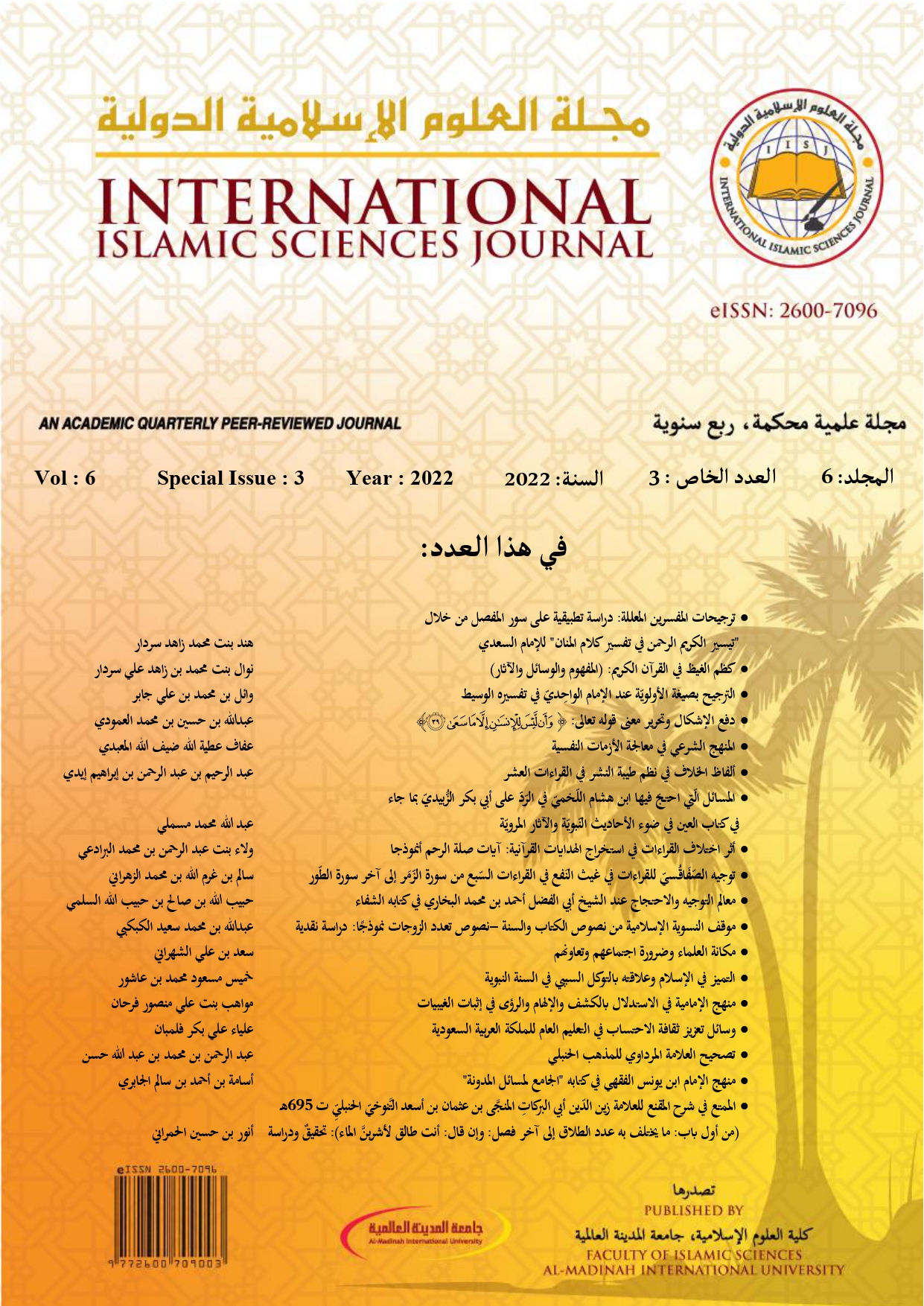
INTERPRETATION OF OBSCURE RELATED TO THE QUR’ĀNIC VERSE: ‘AND THAT MAN CAN HAVE NOTHING BUT WHAT HE DOES GOOD OR BAD’ (Q53:39): AN ANALYTICAL STUDY
Article Sidebar
Main Article Content
Abstract
e problem of the research is concerned with refuting the problematic issues stated in Allah’s saying: ((And that man shall have nothing but what he strives for)). As the apparent meaning of the verse indicates that the servant has no reward other than the reward for his striving. This meaning apparently contradicts what was stated in in Allah’s saying: ((Whoever comes with a good deed will have ten times the like thereof)). As well, Allah’s saying:((And that man shall have nothing but what he strives for)) apparently contradicts what was stated in a number of hadiths indicating that the dead benefit from the striving of others. This contradicts the limitation of the reward to the striving of the servant alone mentioned in the verse of Surat An-Najm. The study aims to identifying the problematic issue of the Quran, to mention its most prominent works, then to refute the problematic issues stated in the verse through clarifying the subject of the problematic issue, and to mention the interpreters who referred to this problematic issue and stating their saying in explaining the meaning of the verse. The study was concluded by mentioning the most correct of these sayings. The approach used in preparing the research is the inductive-analytical approach and the comparative approach. The most prominent findings of the research: 1- The correct saying of the scholars is that Allah’s saying: ((And that man shall have nothing but what he strives for)) is perfect and not abrogated, because the verse is of news, and the news is not abrogated, and what was narrated from Ibn Abbas, may Allah be pleased with them, of the saying of abrogation of the verse is understood as the concept of abrogation among the fore scholars, which differs in its meaning from the idiomatic meaning of the later scholars. 2- The main is that the slave does not possess anything but the striving of himself, but he also benefits from the striving of others, as evidenced by the evidence of the Quran and Sunnah, that is what the Sunni investigator scholars have agreed. Combine the evidence..
This research is concerned with repelling the confusion contained in the Almighty’s saying: “And that man has nothing but that which he strives for” [Surat An-Najm: 39], by clearing the place of the confusion in the verse, and mentioning the commentators who referred to this problem, then listing their sayings in explaining the meaning of the verse and pushing The problem with it, and the study concluded by clarifying the most correct opinion of these sayings