
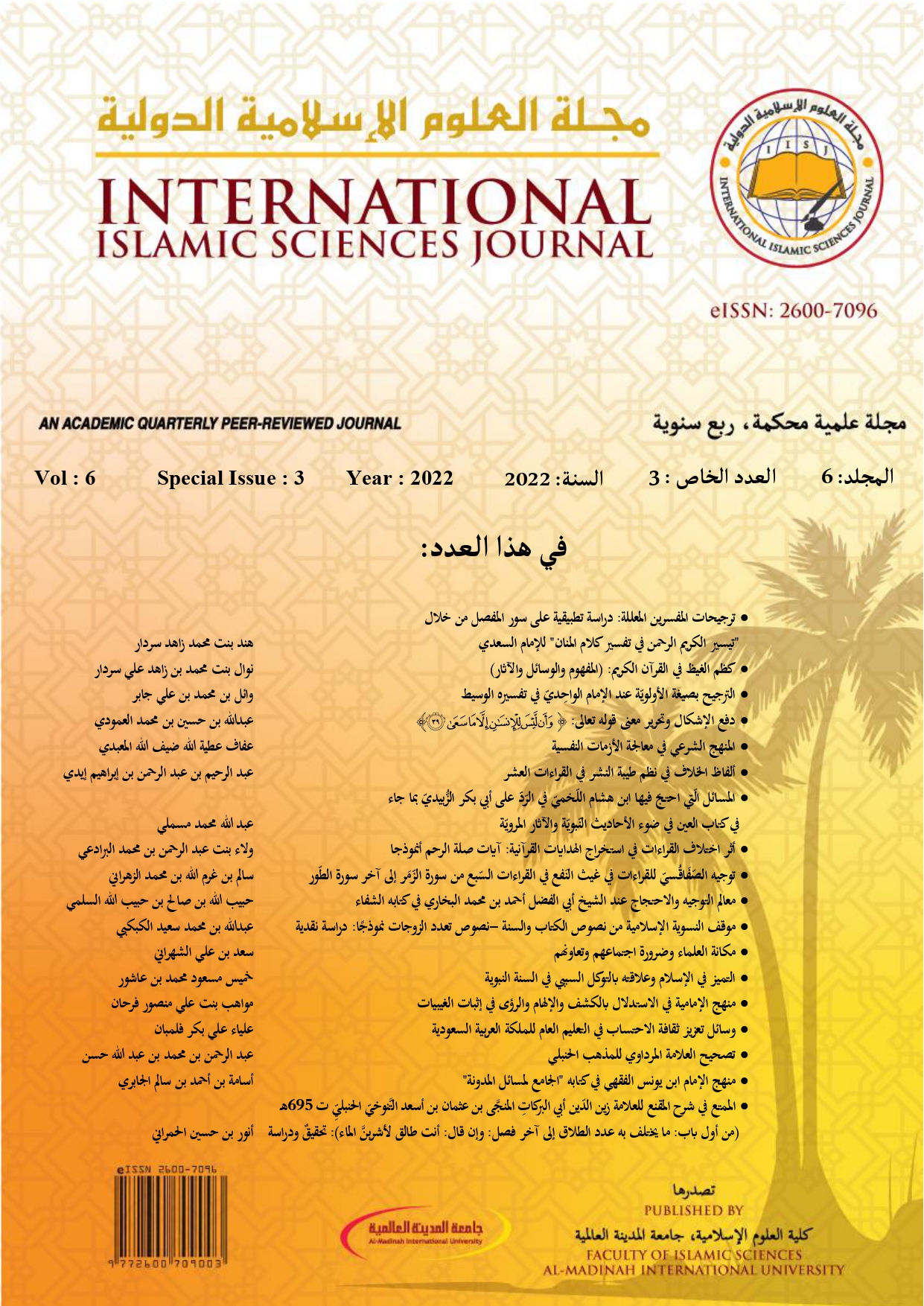
THE REASONED PREFERENCES OF INTERPRETERS OF AL-QURʼĀN: A THEORETICAL AND APPLIED STUDY ON SHORT SURAHS FROM THE BOOK "TAYSĪR AL-KARĪM AL-RAḤMĀN FĪ TAFSĪR KALĀM AL-MANNĀN'' BY AL-IMĀM AL-SAʻDĪ
Article Sidebar
Main Article Content
Abstract
The research was limited to studying the reasoned preferences of interpreters of al-Qurʼān: a theoretical and applied study on short Surahs from the book "Taysīr Al-Karīm Al-Raḥmān Fī Tafsīr Kalām Al-Mannān'' by al-Imām Saʻdī. The study consisted of an introduction, a preface, three chapters, and a conclusion. The research provided a complete conception of the term “the reasoned preferences of interpreters of al-Qurʼān”, as well as observing on the application of al-Imām Saʻdī’s reasoned preferences in the qur’anic text, Sunnah, traditions, the Arabic language. I have supported the correctness of the reasoned preferences stated by al- Saʻdī by the sayings of the interpreters al-Qurʼān that prove the correctness of what the aL-Imām referred to. By employing the inductive analytical approach. The findings of this study were: (1) the scientific power that al-Imām Saʻdī possessed; (2) the book "Taysīr Al-Karīm Al-Raḥmān Fī Tafsīr Kalām Al-Mannān" needs a complete extrapolation to extract the exegetical origins of al-imām al-saʻdī; (3) the book "Taysīr Al-Karīm Al-Raḥmān Fī Tafsīr Kalām Al-Mannān" is one of the most important books of contemporary interpretations of al-Qurʼān , which is indispensable for scholars and academics; (4) the interpreters of al-Qurʼān used in their preferences a correct approach that helps them to reach the truth.